Open-Source AI Quietly Caught Up. Here’s What That Means for Your Business.
Open-weight AI models have nearly closed the gap with closed frontier models. Here's what that shift means for small businesses that want to own their AI.
On this page
 Llama
Llama
 Mistral
 DeepSeek
 Qwen
Qwen
 Hugging Face
 Ollama
A year ago, recommending an open-weight model to a small business felt like a compromise. You’d say “it’s pretty good for free” and quietly mean “it’s worse, but you don’t have to pay a subscription.” That caveat was real. The big closed labs were genuinely ahead, and everyone knew it.
That gap has mostly closed.
Not in a press-release way. In a “I ran the same task through both and couldn’t tell which was which” way. The open models — the ones with weights you can download and run on your own machine — caught up while nobody was watching the scoreboard. And they keep catching up, month after month.
Here’s what that actually means if you run a business.
Closed vs. open, in plain English
Two kinds of AI models exist.
Closed models are the ones you rent. You send your text to a company’s servers, their model does the work, and the answer comes back. You never see the model itself. If they change it, raise the price, or shut the service down, that’s their call, not yours. This is the bigger, more famous category.
Open-weight models are the ones you own. The actual model — the file full of numbers that does the thinking — gets published. You download it. You run it on your hardware or a server you rent. Nobody can take it away, change its behavior overnight, or read what you send it.
For a long time, the trade was simple: closed models were smarter, open models were yours. You picked which one mattered more.
That trade barely exists anymore for normal work.
What “caught up” actually means
Let me be honest about the caveat first, because it’s real.
The absolute frontier — the hardest reasoning, the longest chains of logic, the genuinely novel problems — is still led by the big closed models. If you’re doing PhD-level math or pushing the bleeding edge of what AI can do at all, the closed labs are ahead. I’m not going to pretend otherwise.
But here’s the thing almost nobody says out loud: your business does not run on bleeding-edge reasoning.
Your business runs on tasks like these:
- Drafting and replying to emails
- Summarizing a long document or a meeting
- Answering customer questions from your own knowledge base
- Sorting incoming messages and routing them
- Pulling structured data out of messy text
- Writing first drafts of posts, descriptions, and listings
- Following a checklist of steps without dropping one
For every single one of those, the gap between a good open model and the best closed model is now small enough that it doesn’t change the outcome. The work gets done. The customer can’t tell. You can’t tell either, most of the time.
The frontier kept climbing — but the floor came up to meet the ceiling on everything that pays the bills.
Why this matters more than the benchmarks
When people argue about AI models, they argue about benchmark scores. Who’s a few points ahead this month. That’s a fun spectator sport, and it’s almost completely irrelevant to a small business.
What matters to you is different.
You own it. A model running on your hardware doesn’t get deprecated. There’s no email that says “the version you built your workflow on is being retired in 90 days, please migrate.” The model you tested last spring still works exactly the same next spring. We’ve written before about why you should own your AI instead of renting it — open models are the part that makes ownership actually possible.
The math flips. With a rented model, you pay per use, forever. Every email, every summary, every customer question — the meter runs. With an open model on your own hardware, you pay for the setup once, and then running it costs roughly what it costs to keep a computer on. For a business doing the same kinds of tasks thousands of times a month, that difference adds up fast — and it points the right direction over time, not the wrong one.
Your data stays yours. When you rent a model, your prompts leave your building. Client details, internal numbers, draft strategy — all of it travels to someone else’s server. With an open model running locally, none of it leaves. For anyone handling sensitive customer information, that alone is the whole argument.
No lock-in. You’re not building your business on a platform that can change the rules. The model is a file. You have the file. If something better comes out next month — and it will — you swap it in. If a vendor jacks up their price, it’s not your problem.
The benchmark question is “which model is smartest?” The business question is “which model can I rely on, afford, and control?” Those have different answers.
The trend is the real story
Here’s the part that should change how you plan.
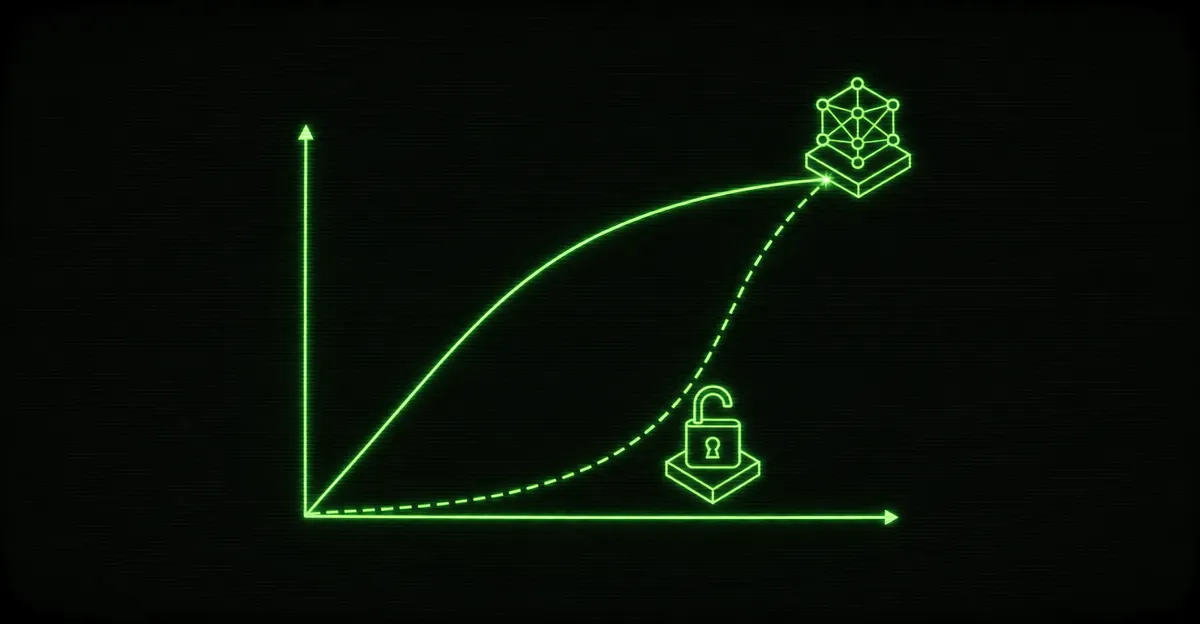
This isn’t a one-time event where open models caught up and now we wait. The gap has been narrowing steadily, release after release. Every few months, a new open model lands that does what last year’s closed flagship did — except you can run it yourself.
The direction is consistent. The capability that’s locked behind a subscription today tends to show up in an open, ownable model not long after. So when you’re deciding what to build a workflow on, you’re not just choosing between today’s options. You’re betting on a trend. And the trend says the stuff you can own keeps getting better faster than the stuff you can only rent.
If you want to actually try this — download a model, run it on a machine you already own, and see how it handles your real tasks — we walk through exactly that in running AI models on your own hardware. It’s more approachable than most people expect.
What we’d actually recommend
Be practical about it. We don’t pick a model out of loyalty to “open” or “closed.” We pick the one that fits the job.
For the hardest, rarest reasoning task that genuinely needs the frontier — sure, reach for a closed model and pay for it. That’s a small slice of real work.
For the day-to-day engine of your business — the agents answering questions, the automations sorting and routing, the systems drafting and summarizing all day long — an open model you own is now the better call far more often than it used to be. Capable enough, cheaper to run at volume, private by default, and immune to a vendor changing the deal on you.
That’s the shift. It happened quietly, and a lot of businesses haven’t noticed yet. The ones that do get a real edge: capable AI, owned outright, with the meter turned off.
If you want AI agents that run on infrastructure you actually own — built around your tasks, your data, and a model that won’t get pulled out from under you — that’s what we build. Tell us what your business does all day, and we’ll show you how much of it can run on a model that’s yours.