The Phone Book Is Dead. Here's How People Actually Find You in 2026.
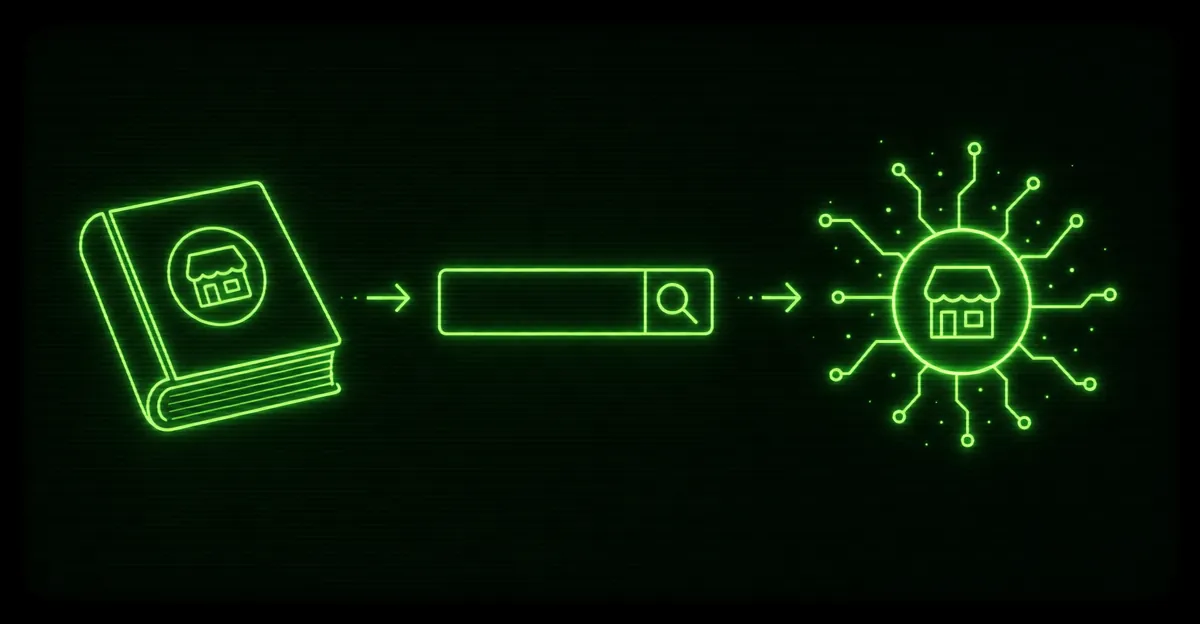
Discovery has moved from the phone book to Google to AI. Where your business has to exist now so both the index and the AI can recommend you.
On this page
 Google
 Gemini
 Perplexity
Somewhere in your area, a business is still paying for a Yellow Pages ad.
I’m not joking. It still exists. And every year, fewer people open the book it lives in. That business isn’t getting fewer customers because it got worse. It’s getting fewer customers because the place people go to find a plumber changed — and the ad stayed exactly where it was.
Getting found has always worked like this. The gatekeeper keeps changing hands. The businesses that move with it stay visible. The ones that don’t quietly fade, convinced they’re doing everything right.
The gatekeeper keeps moving
Think about how discovery actually worked across the last few decades.
The phone book era. If someone needed a service, they grabbed the book, flipped to a category, and called the biggest ad on the page. The gatekeeper was a printed directory and the alphabetical order of your business name. “AAA Plumbing” wasn’t a coincidence.
The Google era. The book went in the recycling. People typed “plumber near me” into a search bar, and a ranking algorithm decided who showed up first. The gatekeeper became the search index — and being findable meant having a website that index could read. The businesses that built one got the calls. The ones who said “I get all my work from word of mouth” slowly stopped showing up.
The AI era — right now. The gatekeeper is shifting again. People are still searching, but more and more they’re asking. They ask an assistant for “a good electrician open on Sunday,” and instead of ten blue links, they get an answer. One recommendation. Maybe three.
Each time the gatekeeper moved, the rule was the same: the businesses that existed where people were looking got found. Everyone else got skipped.
The new gatekeeper answers the question for you
Here’s what’s different about this shift, and why it matters more than the last one.
Google gave you a list. You still chose. You could scroll, compare, click around, and land on the business in position four because you liked their photos. There was room to be discovered even if you weren’t first.
An AI assistant doesn’t hand back a list. It hands back an answer. When someone asks for the best option, the model names a few businesses and stops. If you’re not one of the names, the searcher never even knows you were an option. There’s no page two of an AI answer.
That’s a smaller doorway. And the businesses that fit through it aren’t the loudest or the cheapest. They’re the ones the AI can actually see and trust enough to say out loud.
The phone book rewarded a clever business name. Google rewarded a website. AI rewards being legible — to the machine and to the people who left reviews.
Where you have to exist now
The good news: you don’t need a new trick for every era. The AI layer and the search index want most of the same things. Build for one and you mostly build for both. Three things matter.
1. An indexed website with structured data
This is still the foundation, and it’s non-negotiable. AI assistants don’t invent recommendations out of thin air — they pull from indexed websites, structured data, and reviews. If there’s nothing to index, there’s nothing to recommend.
A website with structured data is the difference between a page a human can read and a page a machine can understand. Structured data is the machine-readable label that spells it out in a form a crawler trusts: this is the business name, this is what they do, this is the service area, these are the hours, this is the phone number. That’s exactly the information an AI needs to confidently name you when someone asks.
Most internet traffic isn’t even human anymore — it’s crawlers and assistants scanning the web to decide who exists. I wrote about what that bot traffic means for your business, and the short version is this: those systems are your new front door, and they can only walk through a door that’s actually there.
2. Consistent listings everywhere
Your name, address, and phone number need to match everywhere they appear — your site, your map profile, every directory. When they don’t match, both Google and the AI layer get less sure it’s the same business, and uncertainty is the enemy of getting recommended.
A model that isn’t sure who you are doesn’t take the risk. It names the business it is sure about.
3. Real reviews
Reviews were always social proof for humans. Now they’re a primary signal for the machine too. When an AI assistant decides which electrician to name, it’s reading the reviews and the patterns inside them. Real, recent, specific reviews tell both the index and the model that you’re active, trusted, and worth saying out loud.
You can’t fake your way through this layer. Which is good news for any business that actually does good work.
The same mistake, a new decade
The plumber with the phone book ad and the business owner who says “I don’t really need a website, I’m on Facebook” are making the identical mistake — one decade apart. Both are standing where customers used to look.
A social page talks to people who already found you. It does almost nothing for the searcher who’s asking an assistant a question right now and getting a single answer back. I’ve made that case in full — your business is invisible without a website — and the AI shift only sharpens the point. Invisible to the index means invisible to the AI means invisible to the customer.
The gatekeeper will keep changing. It always has. The move that’s never changed is showing up where people are actually looking — and building the thing those systems can read, trust, and recommend.
The phone book is dead. The customers aren’t. They’re just asking a different gatekeeper now, and you need to exist on the other side of it.
If you’re not sure whether an AI assistant would recommend you today — or even knows you exist — that’s the right question to be asking, and it’s the one we answer for clients every week. Let’s get your business found.