AI Agents vs. Chatbots: The Difference That Actually Costs You
A chatbot answers questions in a window. An agent remembers, connects to your tools, and takes action. The difference is what makes or breaks your business.
On this page
 Claude
 Discord
 Telegram
 Notion
“We added an AI chatbot to our website.”
I hear this constantly, usually said with pride, and almost always about a little bubble in the corner that answers “what are your hours?” and not much else. That’s fine. But it’s nowhere near the same league as an AI agent, and treating the two as the same thing is the kind of confusion that quietly costs you customers.
Let me end the confusion.
A Chatbot Reacts. An Agent Acts.
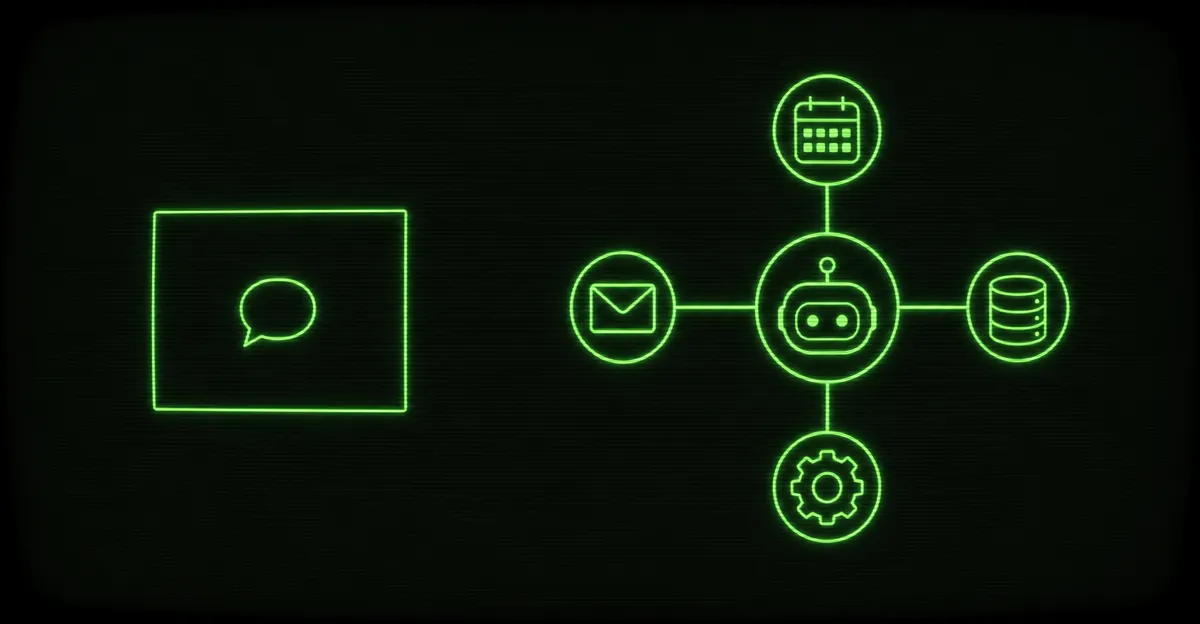
A chatbot is a script. Someone types a question, it matches that question against a list of canned answers, and it spits back a response. It’s reactive — it does nothing until poked. It’s stateless — it forgets you the moment you close the tab. And it lives in exactly one place: a chat window on a screen. Useful for deflecting FAQs. That’s the whole job.
An agent is a different animal. It has persistent memory, so it remembers your business, your preferences, and what happened last week. It runs continuously, not just when someone clicks a bubble. It connects to the real tools you already use — your inbox, your calendar, your CRM, your messaging apps. And it takes multi-step actions on your behalf instead of just answering a question and stopping.
A chatbot tells someone what your hours are. An agent reads the message, checks whether you’re booked, replies, and puts the appointment on your calendar.
That’s the gap. A chatbot hands back answers; an agent actually does the work that comes after the question.
The Same Scenario, Both Ways
Say a potential customer messages you at 9 PM: “Do you have anything open Thursday afternoon? My sink is leaking.”
The chatbot version: It scans for keywords. Maybe it finds “open” and “Thursday,” maybe it doesn’t. Best case, it replies with your business hours and a link to a contact form. The customer now has to fill out the form, wait for you to wake up, wait for you to read it, and wait for you to reply. By then they’ve messaged two other businesses. The chatbot did its one trick — it answered into the void — and the lead cooled off overnight.
The agent version: It reads the message and understands the intent. It checks your actual calendar for Thursday afternoon. It sees you’re free at 2 PM, drafts a reply offering that slot, and either books it directly or holds it pending your okay. It logs the new contact in your CRM and flags “leaking sink” as urgent so you see it first thing. The customer wakes up to a confirmed appointment instead of silence.
Same message. Same 9 PM. One of these keeps the customer. The other hands them to your competitor.
Why “We Added a Chatbot” Sells Itself Short
The trouble with the chatbot framing is that it sets the bar on the floor. People bolt a Q&A bubble onto their site, check the “we have AI now” box, and assume they’ve handled it. They haven’t. They’ve automated the easiest, lowest-value slice of the work — repeating information that’s already on the page.
The expensive work is the stuff that requires action: triaging which message matters, pulling the right context, coordinating across your calendar and inbox and contacts, and actually moving the ball. A chatbot can’t touch any of that because it can’t reach your tools and it can’t remember anything. It isn’t built to. Asking a chatbot to run your front office is like asking a doorbell to answer the door.
Here’s the part that stings: an agent and a chatbot can look identical from the outside. Both might show up as a chat window. The difference is entirely in what’s wired up behind it. Which is exactly why “we have a chatbot” gives people false confidence that they’ve solved a problem they’ve barely scratched.
What an Agent Looks Like in Practice
None of this is hypothetical. Open-source agent frameworks are mature enough to run real operations today. We build a lot of our agent work on top of OpenClaw — an open-source framework for running always-on agents that connect to the tools businesses actually live in.
A properly built agent will, on a typical day:
- Watch the inbox and triage what’s urgent, what’s routine, and what’s spam
- Draft replies in your voice, pulling from your real knowledge base instead of generic AI filler
- Check your calendar and offer or book real time slots
- Update your CRM so contacts and notes don’t fall through the cracks
- Follow up on threads that went quiet, without you remembering to
- Hand off to you the moment something needs a human, with the context already gathered
Notice that none of those are “answer a question.” They’re tasks with steps, and steps that touch your real systems. That’s the line between an agent and a chatbot: a chatbot answers, an agent finishes the job.
So Which Do You Actually Need?
If all you want is to stop typing the same three answers over and over, a chatbot is honestly fine. No shame in it. It’s a fancy FAQ, and a fancy FAQ has its place.
But if the thing actually bleeding money is leads going cold, messages sitting unread, appointments never getting booked, and follow-ups never happening — a chatbot won’t fix any of that, no matter how slick the bubble looks. That’s agent work. The real cost of getting this wrong isn’t measured in software at all. It’s every customer who messaged at 9 PM and got silence.
Most of the value isn’t in the AI itself — that part’s increasingly commodity. It’s in wiring the agent to your real tools, giving it the right context, and keeping it running when things change. That’s the work, and it’s the part that decides whether you got an employee or a doorbell.
If you’re not sure which side of the line your business is on, that’s worth a real conversation. See what our AI agents actually do and we’ll tell you straight whether you need an agent, a chatbot, or neither.